It seems an age since that day in the clearing. The day the darkness tried to take you. The day you were saved.
The good people of Carpenter’s Meadow pulled you away from the creature and chased it into the trees. They brought you back to their sleepy forest town and nursed your body and mind back to health.
The experiences over the days preceding…was it even days? How long had it been since you left the town of Solstice and your bed at the Green Man. The whole thing has felt like a dream, or more likely a nightmare.
I must say you’re looking a good 20 years younger than the day I first saw you in that clearing.
The voice belongs to Donald, the town physician and the man who truly brought you back to yourself again.
The island is a dangerous place. Most people stick to the towns and villages and rarely travel alone, and that goes for island folk. Being an outsider I’m frankly amazed you made it this far, you’re something special it seems, or lucky…
Come. I think it’s time you joined the land of the living again. Ironic really, you’re just in time for the festival of the dead.
Ok so it’s definitely throwing some big names at me recently. I’d say it’s because my collection is so full of classics but really there’s a lot of crap, I just seem to have lucked out so far. Technically this film is the most likely one to come up because it has the most sequels, but still, we’re due something more obscure.
In the meantime I’ll be reviewing John Carpenter’s 1978 classic, Halloween.
So where do I start with a film that’s often credited with being the first Slasher film. I mean probably by pointing out that Black Christmas and about a billion Giallo films came before it. You could even say the 40s Mummy films from Universal fit the bill, but honestly you could get away with saying that Halloween popularised the sub genre.
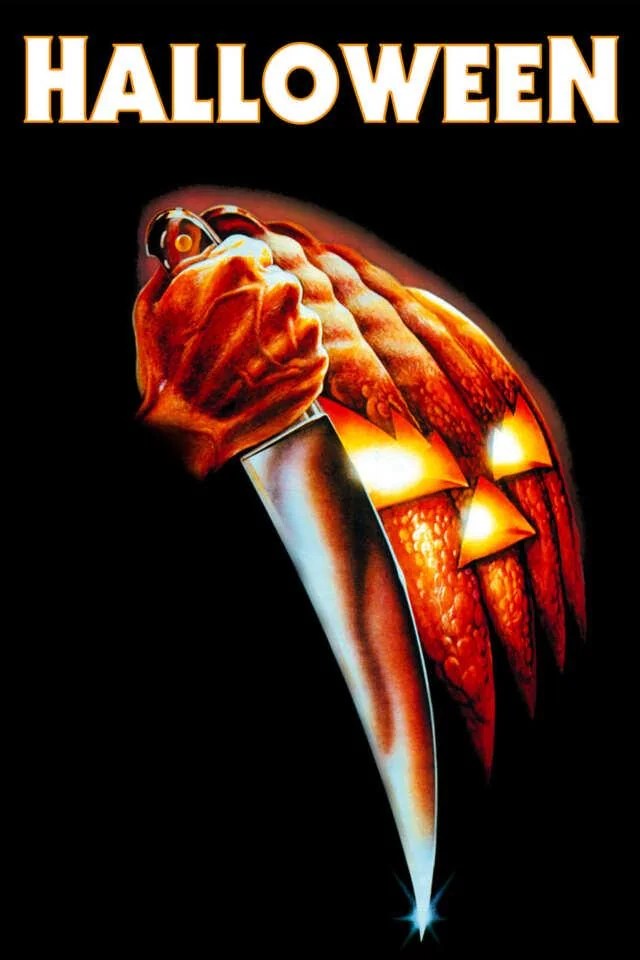
To summarise, Halloween follows Laurie Strode and her high school friends on Halloween night in the town of Haddonfield, as they are stalked by escaped killer Michael Myers. Alongside this, Michael’s doctor from the Asylum, Dr Loomis, tries to convince the police of the danger his escaped patient poses.
Chances are if you think about Slasher films then it’s all about the crazy kills, gore, and dumb teenagers. Well Halloween has one of those, it certainly has dumb teenagers, or should that be it ‘totally’ does, one of the girls is endlessly saying that word. So yes, dumb teenagers, check, but crazy kills and gore, no. It surprises me a bit that this film is an 18 if I’m honest, it’s probably more a case of them not updating the rating to reflect modern sensibilities. The kills, though effective, are pretty gore free, it wasn’t until Friday the 13th came along a couple of years later that gore became the norm for slashers.
From an acting point of view I wouldn’t say that anybody in the film is amazing. Donald Pleasence and Jamie Lee Curtis put in the best performances but I wouldn’t say that either are Oscar worthy. I do very much enjoy how intense Donald Pleasence’s Dr Loomis is though, he puts me in mind of Robert Shaw’s Quint in Jaws. It’s especially amusing because he’s often talking to people who you can tell think he’s exaggerating about the threat of Michael Myers.
If the acting isn’t stand out then the directing certainly is, Halloween has some truly great choices when it comes to visuals. We see first person views fairly regularly, putting us in the Killer’s shoes as we stalk our victims. Then at the other end of the scale we’re made to feel like we have no idea where the killer is, or to feel like he can disappear into thin air. John Carpenter does a great job of creating suspense and a feeling of unease. We know it’s coming, we know he’s coming, but we don’t know when.
A big part of the atmosphere the film provokes is thanks to the score. Again we have John Carpenter to thank for this. His iconic main theme is one of the most recognisable film pieces out there today, so in a way it’s difficult to judge it on it’s own merits outside of “Oh shit, it’s the Halloween theme!” but the fact that it is so recognised speaks volumes. It’s a simple series of piano notes but it elicits a sense that something is coming, and that’s all you need. If you hear that theme song, you’d better get out!
The use of a masked killer, though not unique, goes a long way to give this film a creep factor. The scariest threats are ones where you cannot reason with them, cannot appeal to their humanity. Michael’s mask with its blank expression and black eye sockets takes away any hope that this is a person to be reasoned with, he is a blank, soulless killer. In the credits he is referred to only as, ‘The Shape’, which feels very appropriate.
It’s hard to ignore how much of a big deal this film was when it comes to low budget films making it in the industry. The film made over 70 million dollars with a budget of significantly less than half a million. It opened the floodgates to small independent films coming out of the shadows and becoming household names. Of course this often resulted in them spawning endless increasingly diluted sequels, but the fact that Hollywood gave a shit about them at all was a win for Horror as whole.
Rating time, and this wasn’t as cut and dry as you might think. A bit like with the last film, Nosferatu, despite this being hailed as one of the horror masterpieces I also have to take into account how much I like the film personally. Now this isn’t my favourite Halloween film, it’s not even my 2nd favourite Halloween film. A 5 for me is a film which I think is both well made, which this undoubtedly is, and one which really pushes all the right buttons for me, and ultimately it’s not one of the films that I will choose to watch that often. Therefore I’m going to give Halloween 4 bedsheets out of 5. I’d tell you that you should watch it, but chances are if you’re on a horror review site, you already have. If you asked a random person on the street to name a horror film, there’s a high chance this would be their answer.
**WARNING** SPOILERS BELOW **WARNING**
Welcome to the spoiler section. This is the part where I can bring up some specific parts of the film which I’d like to talk about more, whether they be good, or bad.
A part of the film which never made much sense to me was in the opening sequence when Michael’s sister and her boyfriend go upstairs together. Michael watches them go through the window, then, in the amount of time it takes Michael to go round the back of the house and get the knife from the kitchen, the boyfriend is already leaving. Wow. I feel bad for her, not only does she get stabbed to death by her little brother, but it lasts longer than her boyfriend.
Actually I don’t feel too bad for her, I mentioned before about the acting not being particularly stand out. Well, hers does because it’s pretty lacklustre, I don’t get much of an impression that she’s being stabbed, more that she’s mildly irritated by the knife.
Something else which stood out to me was a scene where Michael is following Tommy Doyle outside the school and for whatever reason we’re not viewing it from Michale’s perspective, instead we’re viewing it from the back seat of the car. At first I thought this was a mistake and it’s supposed to be from the front, but then we see Michael sitting in the front, so maybe it’s more like we, the viewer, are a passenger, along for the ride. I’m pretty sure everything visually in this film is done that way for a reason.
I referenced it earlier but something which you can never unhear is the amount of times the character Lynda uses the word ‘Totally’. She says it all…the…time, 11 times in…total, at least according to the Halloween wiki.
As a last point I should talk about Michael’s seemingly unlimited stamina and resilience. He’s stabbed in the neck, the eye, the chest and then shot 6 times and still manages to get away. Now, as far as we know Michel is just a regular guy. You could put some of it down to adrenaline, particularly the stabbings, but being shot 6 times in the chest and falling from an upstairs window you think would incapacitate him at least longer than the few seconds it takes Dr Loomis to look out of the window. This raises the question, is he really just a man? It’s often theorised that he’s the walking embodiment of evil and so cannot truly be killed, or that he won’t rest until he’s fulfilled some agenda. Personally I like the idea that he represents evil itself, evil that has to steal a car…but still evil…
Odd, I thought I saw somebody staring at me from across the street. It’s probably nothing.
 Summerisle