As you approach the injured child you find yourself distracted by the glowing object. The boy is saying something to you but his voice seems to fade away the closer you get, the colour bleaches from the clearing and your hand reaches out, not to the boy, but to the object.
The boy appears to be shouting now, though his voice is barely audible, a faint whisper in the monochrome shroud. Your fingers brush the object.
A grip like iron fastens itself around your wrist…the boy. You turn, the world is silent now and the child has changed. Beneath a smooth bald scalp his face seems to have elongated, rat-like, his teeth likewise longer now.
You cry out, a silent cry and the boy creature bores into you with a beady intense stare, it draws you in, soothing and terrifying all at once.
Suddenly the rat thing jerks it’s head to the side, it releases it’s grip and you find yourself pulled backwards by strong hands, pulled back into a world of sound, and shouting, and colour.
Wow. OK. This is one of the true milestones of Horror cinema. It’s certainly not the first horror film, not even the first feature length horror film, but it’s probably the one that the most people will have heard of if you mention the silent era of horror. It’s going to be quite a different film to review as well, many of the things we associate with film are either not present here or are in their infancy and I’m going to take all of that into account as I review Nosferatu: A Symphony of Horror, the 1922 original.
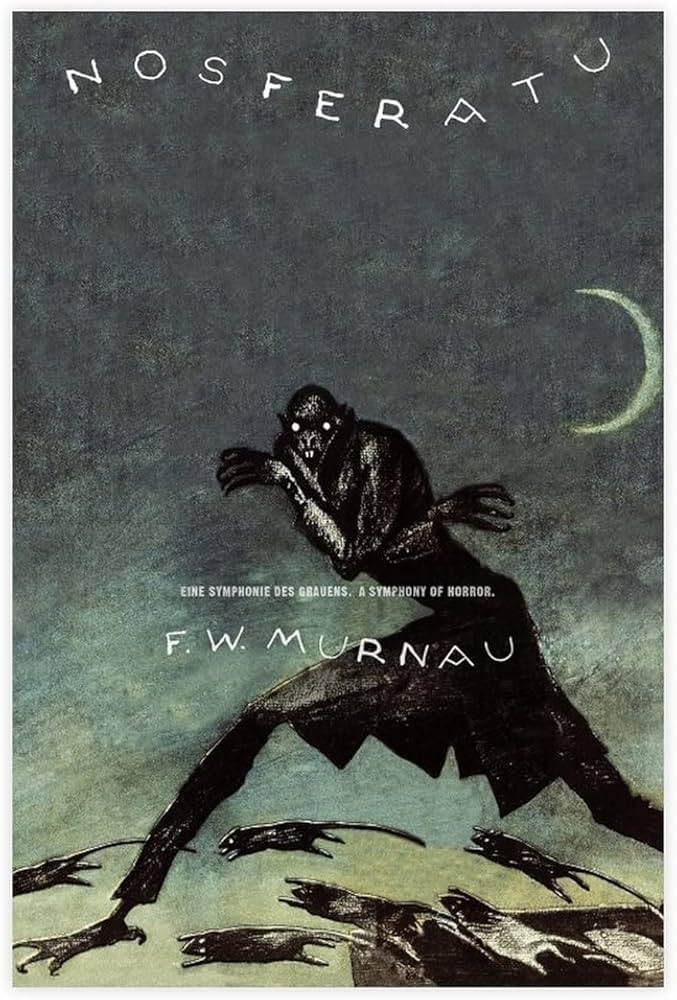
First, since there are a bunch of different prints of this, the version I watched was the Eureka Masters of Cinema Blu-Ray featuring the 2006 restoration. Essentially this just means the colour tints for various parts are a certain way and the musical score is the Berndt Heller re-imagining. For a more in depth look I urge you to read this article by Brent Reid.
So what’s it about? Well, if you’ve read Dracula then…its kind of like that…sort of. It’s an adaptation of Bram Stoker’s novel though it’s certainly not that true to the book. There was in fact a legal dispute at the time with Stoker’s widow who was very much still alive at the time and hadn’t given permission for the material to be used. She won that battle and all copies of the film were ordered to be handed over to be destroyed. Thankfully some copies survived allowing us to view this piece of cinema history over 100 years later. So yeah…it’s Dracula.
Alright, that’s a bit flippant of me. The story is about a young man, Thomas Hutter, who is sent to Transylvania to meet a client of the company he works for. This client, Count Orlok is looking to move to Hutter’s own town of Wisborg in Germany. Hutter soon discovers that the count hides a terrible secret. So yeah…it’s Dracula.
How does one judge the acting in a piece like this? The age of silent cinema is very different, it’s almost a different medium entirely. The actors use exaggerated facial expressions and body movements to portray emotion and action and the results are far more effective than you might think. When combined with the title cards I never found myself lost as to what was happening or how a character was feeling. There is of course the caveat that I have read the book and have seen at least 3 other sound adaptations of the story, but still, the experience did not feel as far removed from a regular sound film as you might expect.
This film is beautiful. The locations we visit, be it rural countryside, gothic castle or industrial town work together is way which feels believable. Interestingly it is set in the early 19th century and not the late 19th almost turn of the century period of the book itself, a period which would have been only about 25 years before this film was made. Perhaps this was done to give it more of an old world mysterious feel, a bit like setting a film made today in the 1930s rather than 1999, both would technically be a period piece but a lot more people remember the later date.
OK I went a bit off track there, but yes, everything looks great, the use of shadow in particular is fantastic, the shot which sticks out in my mind is the iconic shadow of Count Orlok on the stairs where we see only his shadow ascending, clawed hands reaching out, it’s effectively creepy and probably had audiences in 1922 peeking through their fingers. Though not actually scary, certainly not for modern audiences, the film has a fantastic gothic atmosphere and could certainly be described as spooky at the very least. The count himself does vary somewhat though. At times he looks positively goofy whilst at others he appears a true and ominous threat.
The film uses at least a couple of fun special effects that you wouldn’t expect in a film from this era. Firstly we have a scene of Count Orlok rising straight backed from a coffin, an effect apparently combining both mechanical manipulation with a back board and stage hands, and an element of stop motion. The other interesting effect was a character fading out of existence, a fairly simple effect, even at the time but not necessarily one that a filmmaker would think to use. Horror as genre, like sci-fi, really gives great scope for experimentation, for example why would a character fade out in a drama, it’s one of the reasons I find older horror so fascinating to watch.
Rating time, no pressure or anything. So…this is quite difficult. As a piece of cinema history Nosferatu is undoubtedly a 5, however these ratings aren’t really about that though, they’re more about how much I enjoyed them as well as how ‘good’ they are. With that in mind I’m going to give Nosferatu 4 unfortunate scarecrows out of 5. It’s difficult to really judge this film in the same way that sound films are judged, it’s almost a different medium. It’s a beautiful piece of art, but as a movie I found myself at times engaged more due to the necessity of reading the cards or by the novelty of watching something more than a century old, rather than the film’s merits. Having given it that rating though, everybody should see this film at least once. It’s probably not a film you’ll come back to again and again, but it’s a true piece of cinema history.
**WARNING** SPOILERS BELOW **WARNING**
Welcome to the spoiler section. This is the part where I can bring up some specific parts of the film which I’d like to talk about more, whether they be good, or bad.
There were some stand out scenes in the film, for various reasons.
I already mentioned the scene of count Orlok’s shadow ascending the stairs. This is the one that’s often shown in stills of the film, but actually it’s the shots after that which really stood out to me. Count Orlok extends his arm and his hand and fingers appear to elongate and stretch through the doorway. Then as Thomas’s wife Ellen backs away onto the bed the shadow of Orlok’s hand slides onto her body and grasps her heart, it’s a fantastic sequence.
Something else I enjoyed, for entirely different reasons was when an angry crowd, upset by the deaths of so many townsfolk since the Count’s arrival in town, are chasing the madman ‘Knock’, Thomas’s former employer. They are searching for him when one of them sees a scarecrow in a field and they run up to it, cast it down and then proceed to fling it about all over the place. It’s a fun and somewhat unexpected bit of comedy and it made me smile.
Another fun sequence is when Count Orlok disguised as a coach drive picks up Hutter to transport him to the castle. The scenes of the coach driving through the countryside are sped up to give a sense of speed. A common enough effect, often used to make car chases seem more dramatic but for whatever reason I wasn’t expecting to see it here. What it actually did was put me in mind of the fact that old film footage often appears sped up due to the different frame rate, though this isn’t the case here, the film having been adjusted so it appears at amore natural speed.
The other interesting part of the coach scene is that one shot is a negative, though that’s not the whole story. In the shot the coach is travelling through the forest which appears to be glowing white with a black smoke or fog in the foreground. The thing is the coach should appear white here as the ‘colours’ are inverted, but in fact it’s still black, so the shot must have been adjusted somehow to retain the black of the coach. There really are lots of interesting techniques being used.
I’ve talked long enough, darkness draws in, the shadows lengthen, it’s time to go…
 Summerisle